Honors PreCalculus
Online for the 2026-2027 School Year
Teacher: Amelia Chan
Email: mathamelia3@gmail.com
Email: mathamelia3@gmail.com
You are not currently logged in.
You must log-in/sign-up before you can pay tuition for a course.
Log-in/Sign-up to Register.png)
Application
This course is not designed for the AP® Precalculus exam. Students intending to enroll in the AP Precalculus exam should take my AP Precalculus class. For the difference between the two classes, please scroll down for further explanation.
Anyone interested in joining Ms. Chan’s Honors Precalculus class should fill out the application and submit tuition to hold a spot. If you are interested in a self paced version of this course, please sign up via www.mathamelia.com.
Course Description
This course is designed to provide a comprehensive study of functions, which are the basis of calculus and other higher mathematics courses. The students will study the properties and graphs of trigonometric, polynomial, rational, inverse, exponential and logarithmic functions, inequalities, polar coordinates, complex numbers, conic sections, matrices, vectors, sequences, series, counting and probability. Students who successfully complete this course will be ready to take AP® Calculus and college Calculus.
Who Should Apply?
Students should have successfully completed Geometry and Honors Algebra II. Students who have not completed Algebra II should enroll in Honors Algebra II before taking this course.
Why Take This Class?
Honors Precalculus
- Prepares students for calculus (including AP Calculus AB and BC) and to succeed in both STEM and non-STEM majors.
- Students who want to complete a fourth year of math in high school. Students who take math all 4 years of high school are 140.5% more likely to be considered “college ready” and “calculus ready.”
What is the difference between AP Precalculus and Honors Precalculus?
Both courses provide excellent preparation for calculus, and each class includes instructor created video lectures. The AP class is not harder than the Honors class; the primary difference is that the Honors Precalculus course does not include live sessions. Students can ask questions in the discussion forum, where both the TA and the instructors provide answers, and many students have found success through this format.
For students who wish to take an AP exam as a capstone to their high school math education, AP Precalculus is an excellent choice. However, for students planning to take calculus in high school, an AP Precalculus class is not strictly necessary. If your goal is to take the AP Precalculus exam, the AP course will thoroughly prepare you to succeed. Taking the AP class does not require you to take the AP exam, and you may still list AP Precalculus on your transcript. Additionally, some homeschool families prefer an AP class for the weighted GPA benefit.
Course Fee
Early Bird Special: $599
After June 30: $650
Textbook and Materials
Precalculus by Margaret L. Lial, John Hornsby, David I. Schneider, and Callie Daniels. Students must purchase multi-term access to MyLab that include eText, online homework, and tests. Instructions will be provided a few weeks before school begins.
Technical Requirements
- Computer with high speed internet access, email capability and camera
- Smartphone or scanner to save multiple handwritten pages as a single PDF file
- Graphing calculator: TI 89, TI Nspire, or TI 83/84 PlusStudents may use other graphing calculators; however, a College Board approved calculator is a good investment and can be used for years to come.
Course Delivery
Students access class materials on Canvas and MyLab at any time. All materials are available 24/7.
- Video lectures produced by Ms. Chan
- Weekly homework assignments
- Chapter tests and exams
- Discussion forum monitored by TAs and the instructors
- There is no live class component for this course
Course Schedule
The course runs from August 24, 2026 through early May 2027. Thanksgiving, winter, and spring breaks are included. Exact dates are to be determined.
Grading and Assessment
- Homework: Homework is extremely important. Students’ success in this class depends on their ability to complete and understand the homework problems. Watch the video lessons and complete the homework.
- Chapter Tests: There will be a test at the end of each chapter.
- Exams: There will be a midterm and final exam.
Questions and Support
Students may ask questions through the discussion forum. The instructors and TAs will answer the questions.
Instructor Qualifications
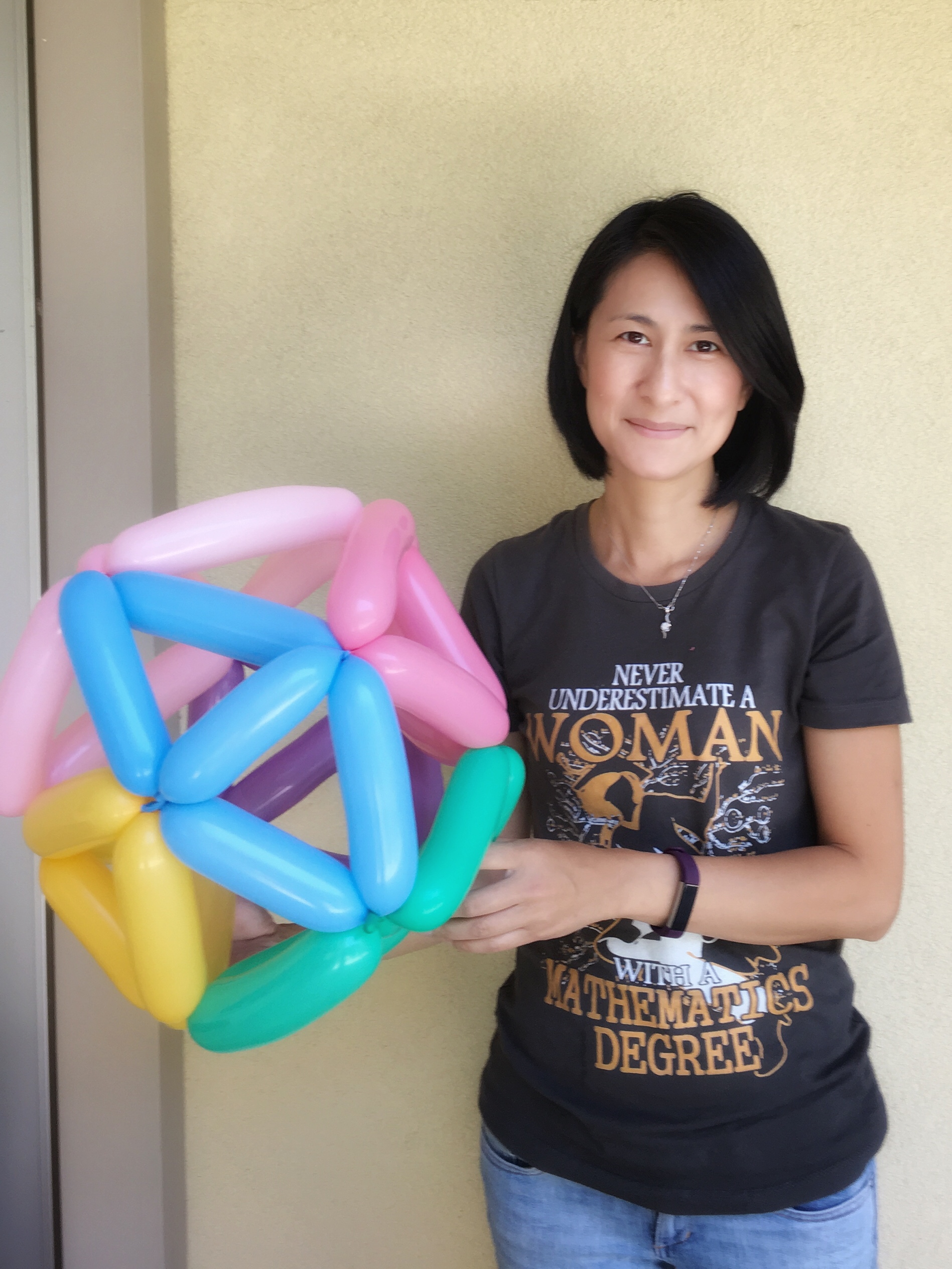
Amelia Chan
She holds an M.A. in Mathematics from Columbia University in New York and dual B.A. degrees in Mathematics and Statistics from the University of California, Berkeley. She is a math instructor at De Anza College. Her professional background includes work as an Investment Banker, Financial Software Engineer, and Actuarial Consultant. After her children began school, she chose to homeschool them, designing customized courses to fit their individual abilities and needs. Through this experience, she began teaching mathematics to homeschool co ops and after school programs. Many of her students have excelled academically and won national math competitions. She has taught mathematics online and in person for over 20 years and is passionate about teaching students from around the world and supporting their success in mathematics. For more information about her and her teaching philosophy, please visit www.mathamelia.com.